RealityGuru is an AR-led trail through Tate Britain for young children — voxel character guides, physical stamps, and a redesigned map that work together to turn a formal gallery into a route worth following.
01 WHY THIS MATTERS
Children are present in the gallery, but rarely engaged by it.
The behavioural data here is softer than in clinical or consumer projects — fieldwork was small-scale and observational. Rather than stack thin numbers, this block leans on one strong figure and one moment from the floor.
min
Average time a child aged 5–8 spends actively engaged with artwork on a family museum visit before disengaging.
Source — Fieldwork synthesis, n=8 children
"She walked into the room, looked at one painting, then asked if we could go to the gift shop. We'd been inside for nine minutes."
— Parent, observed visit · Tate Britain, Room 9
min
Average time a child aged 5–8 spends actively engaged with artwork on a family museum visit before disengaging.
Source — Fieldwork synthesis, n=8 children
"She walked into the room, looked at one painting, then asked if we could go to the gift shop. We'd been inside for nine minutes."
— Parent, observed visit · Tate Britain, Room 9
min
Average time a child aged 5–8 spends actively engaged with artwork on a family museum visit before disengaging.
Source — Fieldwork synthesis, n=8 children
"She walked into the room, looked at one painting, then asked if we could go to the gift shop. We'd been inside for nine minutes."
— Parent, observed visit · Tate Britain, Room 9
02 THE GAP
Three frictions, one underlying problem.
The gallery isn't designed against children — it's designed without them in mind. Three friction points repeated across observation sessions, each addressable with a different design lever.
F·01
Navigation
The Tate map assumes adult literacy and adult patience. Children rely on adults to orient, which removes their sense of agency in the space.
F·02
Content
Wall text is written for adults. Children skip it entirely, which means they look at images without context and lose interest within seconds.
F·03
Engagement
There's no feedback loop — no progress, no reward, no reason to move from one room to the next other than parental momentum.
03 CORE LOOP
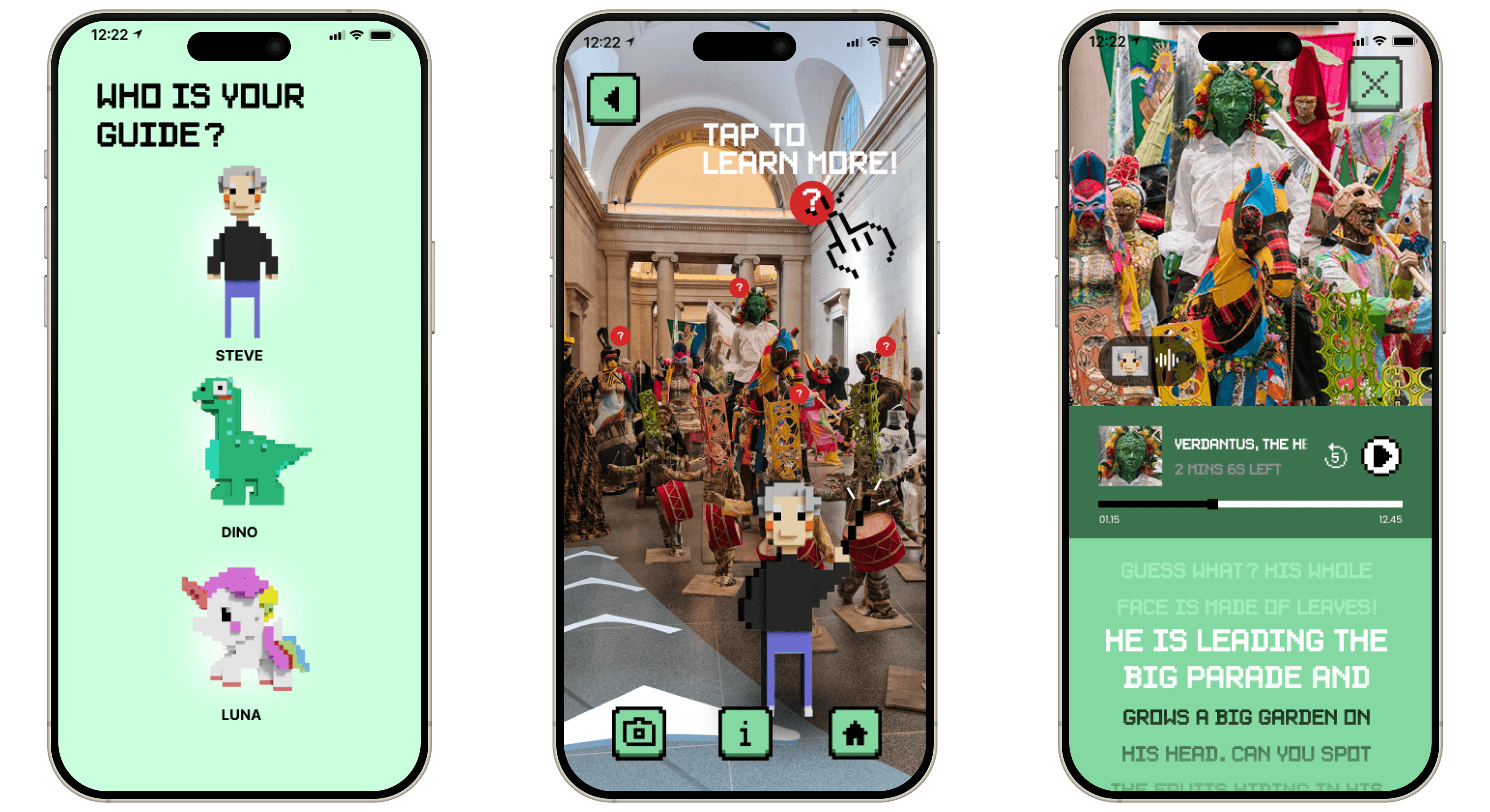
Choose a guide, follow the trail, learn the art.
Select guide → AR navigation → artwork discovery
04 PRODUCT RESPONSE
One product, four pillars.
01
Guide
A voxel character leads the child room-to-room. The guide is the carrier of voice, tone, and pace.
02
Discover
AR overlays sit on the artworks themselve- characters, animate, and bring static paintings to life.
03
Reward
Each room completed unlocks a small digital prize - a sticker, sound, new fact from the guide.
04
Collect
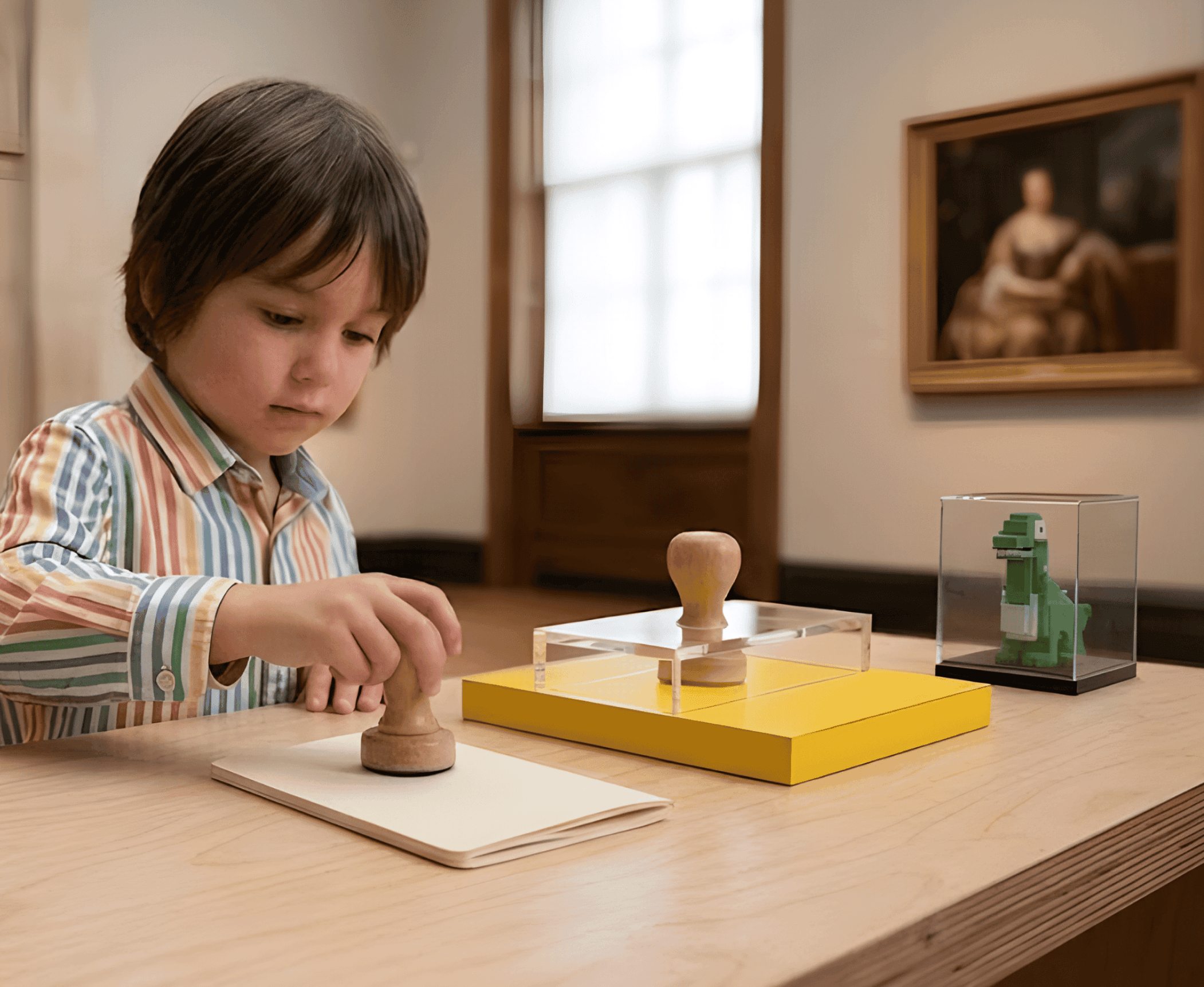
Physical stamps in the brochure, earned at touchpoints in gallery. The trail leaves a tangible trace.
01
Guide
A voxel character leads the child room-to-room. The guide is the carrier of voice, tone, and pace.
Step 1
Guide
A voxel character leads the child room-to-room. The guide is the carrier of voice, tone, and pace.
Step 1
Guide
A voxel character leads the child room-to-room. The guide is the carrier of voice, tone, and pace.
Step 1
Guide
A voxel character leads the child room-to-room. The guide is the carrier of voice, tone, and pace.
01
Guide
A voxel character leads the child room-to-room. The guide is the carrier of voice, tone, and pace.
Step 1
Guide
A voxel character leads the child room-to-room. The guide is the carrier of voice, tone, and pace.
Step 1
Guide
A voxel character leads the child room-to-room. The guide is the carrier of voice, tone, and pace.
Step 1
Guide
A voxel character leads the child room-to-room. The guide is the carrier of voice, tone, and pace.
05 KEY JOURNEY
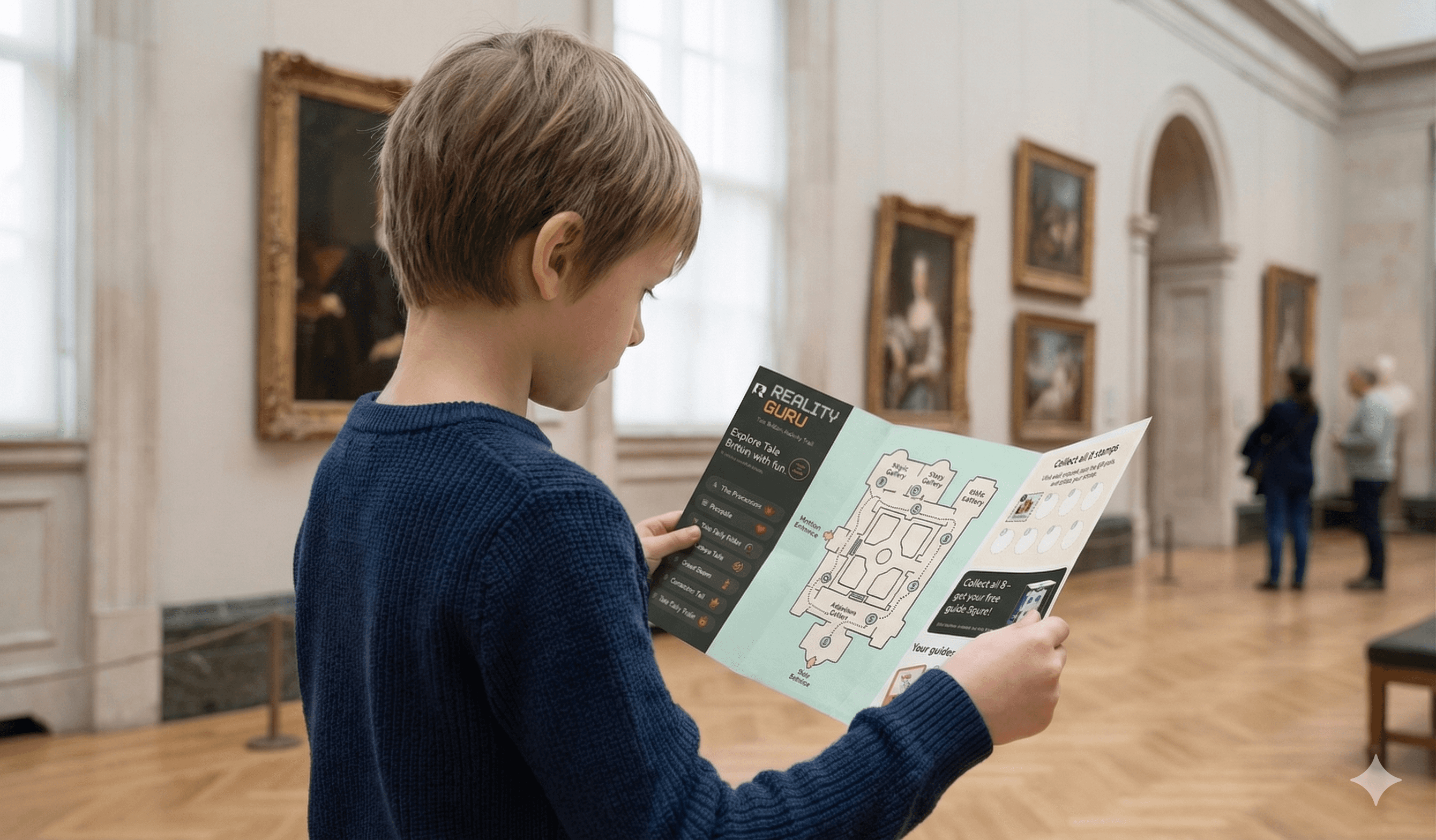
The journey is spatial, not screen-by-screen.
Most case studies show AR as a row of phone mockups. That misrepresents what's actually happening — the user is in a room, looking at an object, holding a device. This visual must communicate that physical context.
06 CHARACTER SYSTEM
Three guides on the move
GUIDE · 01
Steve
FOR THE HESITANT CHILD
Quiet, gentle voice. Waits for the child to look first, then explains. Best for visitors who freeze in unfamiliar rooms.
GUIDE · 02
Dino
FOR THE EXPLORER
Fast, curious, suggests detours. Best for children who want to run ahead and would otherwise leave the trail entirely.
GUIDE · 03
BOBO
FOR THE SOCIAL CHILD
Talks back, asks questions, prompts the child to share answers with their parent. Best for visitors who engage through conversation.
GUIDE · 01
Steve
FOR THE HESITANT CHILD
Quiet, gentle voice. Waits for the child to look first, then explains. Best for visitors who freeze in unfamiliar rooms.
GUIDE · 02
Dino
FOR THE EXPLORER
Fast, curious, suggests detours. Best for children who want to run ahead and would otherwise leave the trail entirely.
GUIDE · 03
BOBO
FOR THE SOCIAL CHILD
Talks back, asks questions, prompts the child to share answers with their parent. Best for visitors who engage through conversation.
GUIDE · 01
Steve
FOR THE HESITANT CHILD
Quiet, gentle voice. Waits for the child to look first, then explains. Best for visitors who freeze in unfamiliar rooms.
GUIDE · 02
Dino
FOR THE EXPLORER
Fast, curious, suggests detours. Best for children who want to run ahead and would otherwise leave the trail entirely.
GUIDE · 03
BOBO
FOR THE SOCIAL CHILD
Talks back, asks questions, prompts the child to share answers with their parent. Best for visitors who engage through conversation.
07 TOUCHPOINT SYSTEM
Physical and digital, working as one trail.
Each touchpoint does a job the others can't. The physical artefacts ground the experience; the digital layer animates it. Together they form a single service — not two parallel ones.
PHYSICAL
Brochure
Carries the stamp page. The trail's spine and the take-home artefact.
PHYSICAL
Map
The child-legible redesign — landmarks and colour zones instead of room numbers.
PHYSICAL
Stamps
Earned at each completed room. The physical reward that paces the trail.
PHYSICAL
Figures
Collectible voxel guides — a souvenir that ties the digital character to something real.
PHYSICAL
Brochure
Carries the stamp page. The trail's spine and the take-home artefact.
PHYSICAL
Map
The child-legible redesign — landmarks and colour zones instead of room numbers.
PHYSICAL
Stamps
Earned at each completed room. The physical reward that paces the trail.
PHYSICAL
Figures
Collectible voxel guides — a souvenir that ties the digital character to something real.
PHYSICAL
Brochure
Carries the stamp page. The trail's spine and the take-home artefact.
PHYSICAL
Map
The child-legible redesign — landmarks and colour zones instead of room numbers.
PHYSICAL
Stamps
Earned at each completed room. The physical reward that paces the trail.
PHYSICAL
Figures
Collectible voxel guides — a souvenir that ties the digital character to something real.
08 MAP REDESIGN
A new map children can read on their own.
The original Tate Britain map is a beautiful piece of institutional design — and almost completely illegible to a young child. Redesigning it surfaced the difference between an information architecture for adults and one for children. Each rooms were also named with romanic numbers and I explicitly named them with interesting english names.
BEFORE
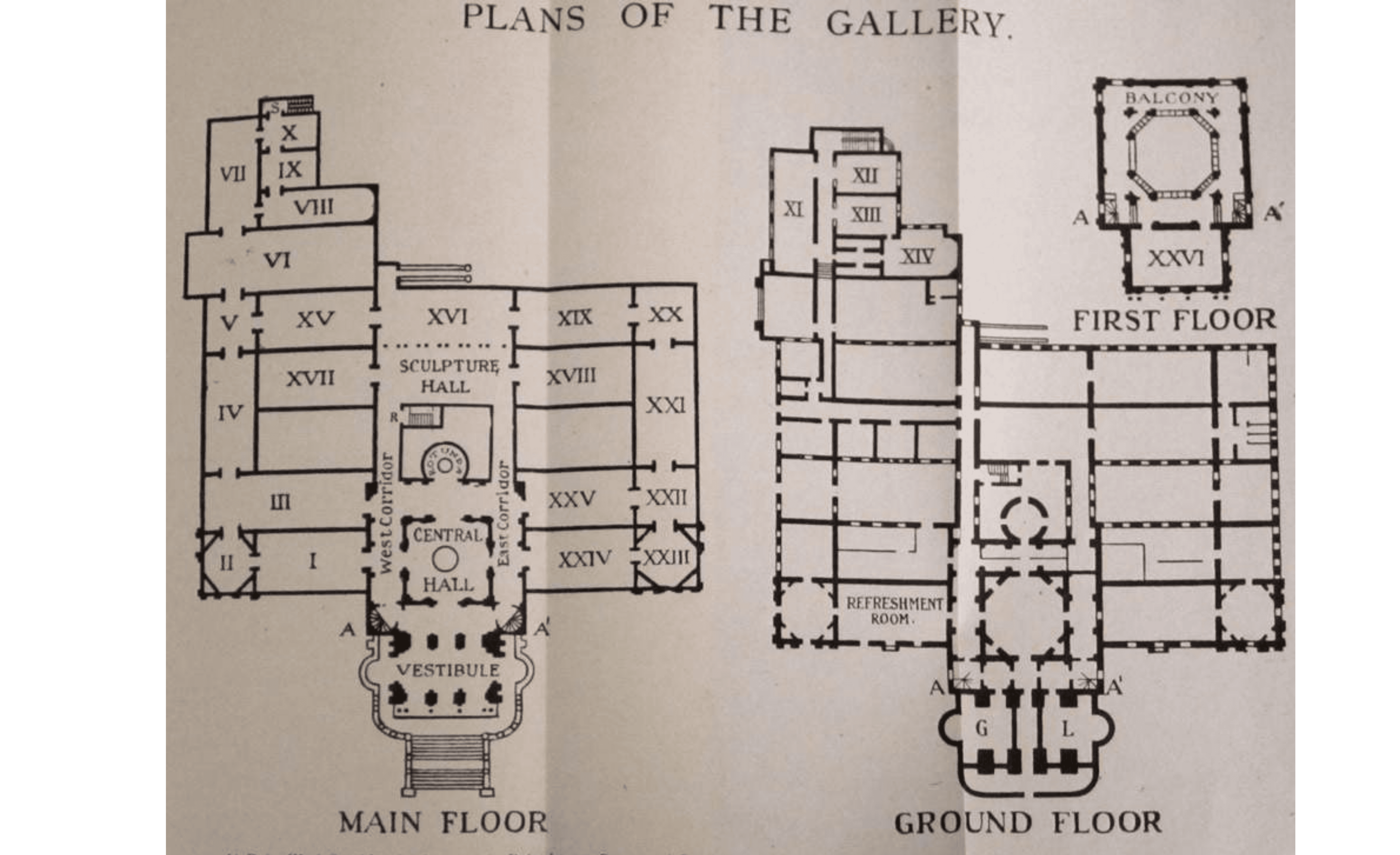
Original Tate Britain map — designed for adult wayfinding.
AFTER
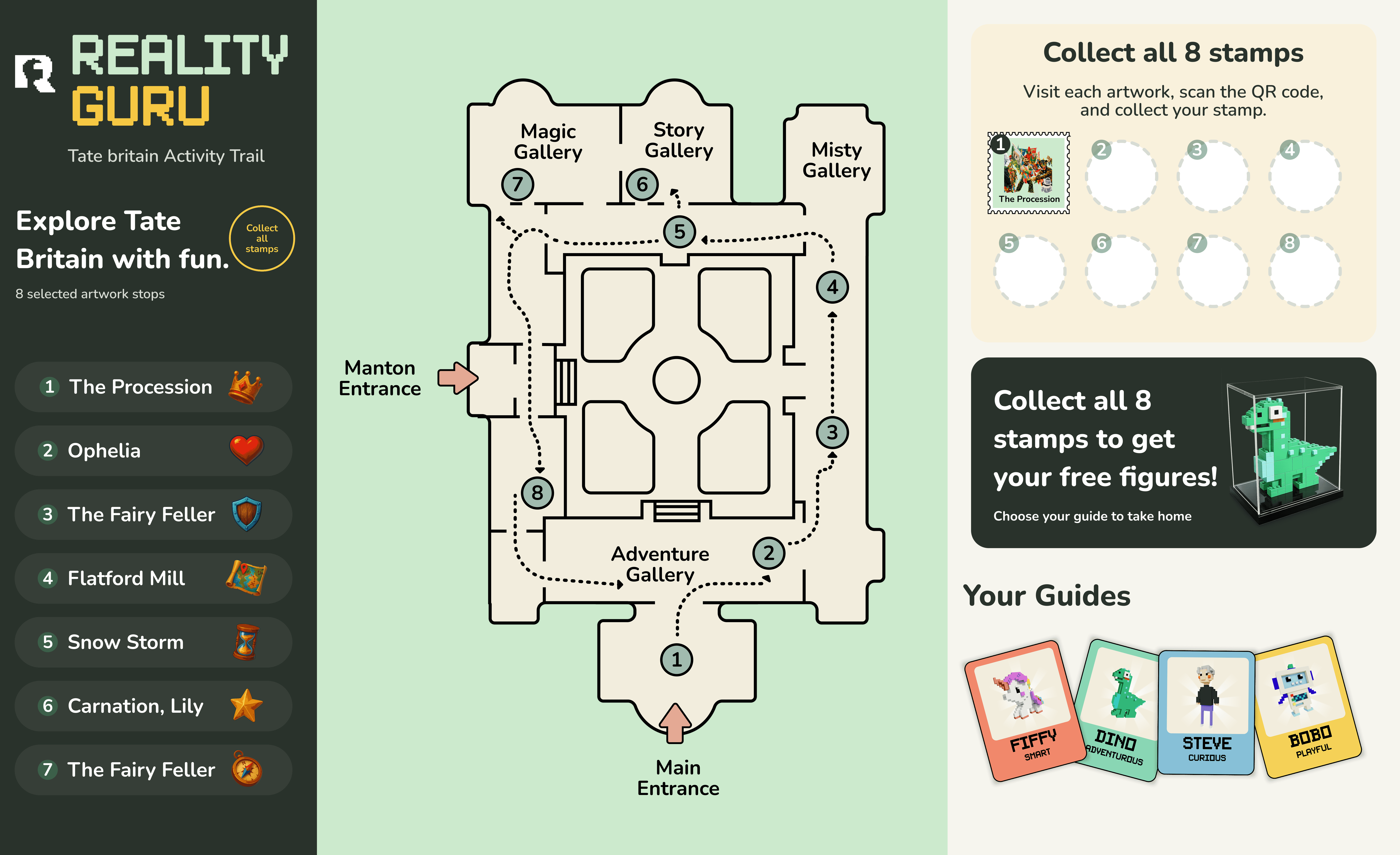
Redesigned map — landmarks, colour zones, character markers.
BEFORE
Original Tate Britain map — designed for adult wayfinding.
AFTER
Redesigned map — landmarks, colour zones, character markers.
BEFORE
Original Tate Britain map — designed for adult wayfinding.
AFTER
Redesigned map — landmarks, colour zones, character markers.
Finding
In informal walkthroughs, 5 of 5 children oriented to the redesigned map over the original.
Finding
In informal walkthroughs, 5 of 5 children oriented to the redesigned map over the original.
Finding
In informal walkthroughs, 5 of 5 children oriented to the redesigned map over the original.
09 REFLECTION
An honest account of where the project landed.
Three short notes — what worked, what was tested so far, and what's next. The middle bullet is the honest one: validation has begun, but not yet at scale, and not yet inside the gallery.
What worked
Pairing voxel guides with physical touchpoints (stamps, brochure, map) gave the trail a tangible rhythm. Children responded to the character-first framing more reliably than to the AR mechanic itself — the guide was the hook, the AR was the reward.
Tested so far
Validated informally with 8 children, aged 5-12, 3 parents, and 1 museum educator through paper prototypes, character preference sorting, and walkthroughs of the redesigned map. Early signals on character attachment and map legibility were strong. In-gallery validation at scale is the next milestone — the AR layer specifically needs to be observed in the physical space it was designed for.
What's next
A scoped pilot inside Tate Britain with a recruited cohort of family visitors, measuring dwell time at artworks, trail completion rate, and which guide characters get chosen most. Findings will feed a second iteration of the character system and the reward economy.
What worked
Pairing voxel guides with physical touchpoints (stamps, brochure, map) gave the trail a tangible rhythm. Children responded to the character-first framing more reliably than to the AR mechanic itself — the guide was the hook, the AR was the reward.
Tested so far
Validated informally with 8 children, aged 5-12, 3 parents, and 1 museum educator through paper prototypes, character preference sorting, and walkthroughs of the redesigned map. Early signals on character attachment and map legibility were strong. In-gallery validation at scale is the next milestone — the AR layer specifically needs to be observed in the physical space it was designed for.
What's next
A scoped pilot inside Tate Britain with a recruited cohort of family visitors, measuring dwell time at artworks, trail completion rate, and which guide characters get chosen most. Findings will feed a second iteration of the character system and the reward economy.
What worked
Pairing voxel guides with physical touchpoints (stamps, brochure, map) gave the trail a tangible rhythm. Children responded to the character-first framing more reliably than to the AR mechanic itself — the guide was the hook, the AR was the reward.
Tested so far
Validated informally with 8 children, aged 5-12, 3 parents, and 1 museum educator through paper prototypes, character preference sorting, and walkthroughs of the redesigned map. Early signals on character attachment and map legibility were strong. In-gallery validation at scale is the next milestone — the AR layer specifically needs to be observed in the physical space it was designed for.
What's next
A scoped pilot inside Tate Britain with a recruited cohort of family visitors, measuring dwell time at artworks, trail completion rate, and which guide characters get chosen most. Findings will feed a second iteration of the character system and the reward economy.

RealityGuru is an AR-led trail through Tate Britain for young children — voxel character guides, physical stamps, and a redesigned map that work together to turn a formal gallery into a route worth following.
01 WHY THIS MATTERS
Children are present in the gallery, but rarely engaged by it.
The behavioural data here is softer than in clinical or consumer projects — fieldwork was small-scale and observational. Rather than stack thin numbers, this block leans on one strong figure and one moment from the floor.
min
Average time a child aged 5–8 spends actively engaged with artwork on a family museum visit before disengaging.
Source — Fieldwork synthesis, n=8 children
"She walked into the room, looked at one painting, then asked if we could go to the gift shop. We'd been inside for nine minutes."
— Parent, observed visit · Tate Britain, Room 9
min
Average time a child aged 5–8 spends actively engaged with artwork on a family museum visit before disengaging.
Source — Fieldwork synthesis, n=8 children
"She walked into the room, looked at one painting, then asked if we could go to the gift shop. We'd been inside for nine minutes."
— Parent, observed visit · Tate Britain, Room 9
min
Average time a child aged 5–8 spends actively engaged with artwork on a family museum visit before disengaging.
Source — Fieldwork synthesis, n=8 children
"She walked into the room, looked at one painting, then asked if we could go to the gift shop. We'd been inside for nine minutes."
— Parent, observed visit · Tate Britain, Room 9
02 THE GAP
Three frictions, one underlying problem.
The gallery isn't designed against children — it's designed without them in mind. Three friction points repeated across observation sessions, each addressable with a different design lever.
F·01
Navigation
The Tate map assumes adult literacy and adult patience. Children rely on adults to orient, which removes their sense of agency in the space.
F·02
Content
Wall text is written for adults. Children skip it entirely, which means they look at images without context and lose interest within seconds.
F·03
Engagement
There's no feedback loop — no progress, no reward, no reason to move from one room to the next other than parental momentum.
03 CORE LOOP
Choose a guide, follow the trail, learn the art.
Select guide → AR navigation → artwork discovery
04 PRODUCT RESPONSE
One product, four pillars.
01
Guide
A voxel character leads the child room-to-room. The guide is the carrier of voice, tone, and pace.
02
Discover
AR overlays sit on the artworks themselve- characters, animate, and bring static paintings to life.
03
Reward
Each room completed unlocks a small digital prize - a sticker, sound, new fact from the guide.
04
Collect
Physical stamps in the brochure, earned at touchpoints in gallery. The trail leaves a tangible trace.
01
Guide
A voxel character leads the child room-to-room. The guide is the carrier of voice, tone, and pace.
Step 1
Guide
A voxel character leads the child room-to-room. The guide is the carrier of voice, tone, and pace.
Step 1
Guide
A voxel character leads the child room-to-room. The guide is the carrier of voice, tone, and pace.
Step 1
Guide
A voxel character leads the child room-to-room. The guide is the carrier of voice, tone, and pace.
01
Guide
A voxel character leads the child room-to-room. The guide is the carrier of voice, tone, and pace.
Step 1
Guide
A voxel character leads the child room-to-room. The guide is the carrier of voice, tone, and pace.
Step 1
Guide
A voxel character leads the child room-to-room. The guide is the carrier of voice, tone, and pace.
Step 1
Guide
A voxel character leads the child room-to-room. The guide is the carrier of voice, tone, and pace.
05 KEY JOURNEY
The journey is spatial, not screen-by-screen.
Most case studies show AR as a row of phone mockups. That misrepresents what's actually happening — the user is in a room, looking at an object, holding a device. This visual must communicate that physical context.
06 CHARACTER SYSTEM
Three guides on the move
GUIDE · 01
Steve
FOR THE HESITANT CHILD
Quiet, gentle voice. Waits for the child to look first, then explains. Best for visitors who freeze in unfamiliar rooms.
GUIDE · 02
Dino
FOR THE EXPLORER
Fast, curious, suggests detours. Best for children who want to run ahead and would otherwise leave the trail entirely.
GUIDE · 03
BOBO
FOR THE SOCIAL CHILD
Talks back, asks questions, prompts the child to share answers with their parent. Best for visitors who engage through conversation.
GUIDE · 01
Steve
FOR THE HESITANT CHILD
Quiet, gentle voice. Waits for the child to look first, then explains. Best for visitors who freeze in unfamiliar rooms.
GUIDE · 02
Dino
FOR THE EXPLORER
Fast, curious, suggests detours. Best for children who want to run ahead and would otherwise leave the trail entirely.
GUIDE · 03
BOBO
FOR THE SOCIAL CHILD
Talks back, asks questions, prompts the child to share answers with their parent. Best for visitors who engage through conversation.
GUIDE · 01
Steve
FOR THE HESITANT CHILD
Quiet, gentle voice. Waits for the child to look first, then explains. Best for visitors who freeze in unfamiliar rooms.
GUIDE · 02
Dino
FOR THE EXPLORER
Fast, curious, suggests detours. Best for children who want to run ahead and would otherwise leave the trail entirely.
GUIDE · 03
BOBO
FOR THE SOCIAL CHILD
Talks back, asks questions, prompts the child to share answers with their parent. Best for visitors who engage through conversation.
07 TOUCHPOINT SYSTEM
Physical and digital, working as one trail.
Each touchpoint does a job the others can't. The physical artefacts ground the experience; the digital layer animates it. Together they form a single service — not two parallel ones.
PHYSICAL
Brochure
Carries the stamp page. The trail's spine and the take-home artefact.
PHYSICAL
Map
The child-legible redesign — landmarks and colour zones instead of room numbers.
PHYSICAL
Stamps
Earned at each completed room. The physical reward that paces the trail.
PHYSICAL
Figures
Collectible voxel guides — a souvenir that ties the digital character to something real.
PHYSICAL
Brochure
Carries the stamp page. The trail's spine and the take-home artefact.
PHYSICAL
Map
The child-legible redesign — landmarks and colour zones instead of room numbers.
PHYSICAL
Stamps
Earned at each completed room. The physical reward that paces the trail.
PHYSICAL
Figures
Collectible voxel guides — a souvenir that ties the digital character to something real.
PHYSICAL
Brochure
Carries the stamp page. The trail's spine and the take-home artefact.
PHYSICAL
Map
The child-legible redesign — landmarks and colour zones instead of room numbers.
PHYSICAL
Stamps
Earned at each completed room. The physical reward that paces the trail.
PHYSICAL
Figures
Collectible voxel guides — a souvenir that ties the digital character to something real.
08 MAP REDESIGN
A new map children can read on their own.
The original Tate Britain map is a beautiful piece of institutional design — and almost completely illegible to a young child. Redesigning it surfaced the difference between an information architecture for adults and one for children. Each rooms were also named with romanic numbers and I explicitly named them with interesting english names.
BEFORE
Original Tate Britain map — designed for adult wayfinding.
AFTER
Redesigned map — landmarks, colour zones, character markers.
BEFORE
Original Tate Britain map — designed for adult wayfinding.
AFTER
Redesigned map — landmarks, colour zones, character markers.
BEFORE
Original Tate Britain map — designed for adult wayfinding.
AFTER
Redesigned map — landmarks, colour zones, character markers.
Finding
In informal walkthroughs, 5 of 5 children oriented to the redesigned map over the original.
Finding
In informal walkthroughs, 5 of 5 children oriented to the redesigned map over the original.
Finding
In informal walkthroughs, 5 of 5 children oriented to the redesigned map over the original.
09 REFLECTION
An honest account of where the project landed.
Three short notes — what worked, what was tested so far, and what's next. The middle bullet is the honest one: validation has begun, but not yet at scale, and not yet inside the gallery.
What worked
Pairing voxel guides with physical touchpoints (stamps, brochure, map) gave the trail a tangible rhythm. Children responded to the character-first framing more reliably than to the AR mechanic itself — the guide was the hook, the AR was the reward.
Tested so far
Validated informally with 8 children, aged 5-12, 3 parents, and 1 museum educator through paper prototypes, character preference sorting, and walkthroughs of the redesigned map. Early signals on character attachment and map legibility were strong. In-gallery validation at scale is the next milestone — the AR layer specifically needs to be observed in the physical space it was designed for.
What's next
A scoped pilot inside Tate Britain with a recruited cohort of family visitors, measuring dwell time at artworks, trail completion rate, and which guide characters get chosen most. Findings will feed a second iteration of the character system and the reward economy.
What worked
Pairing voxel guides with physical touchpoints (stamps, brochure, map) gave the trail a tangible rhythm. Children responded to the character-first framing more reliably than to the AR mechanic itself — the guide was the hook, the AR was the reward.
Tested so far
Validated informally with 8 children, aged 5-12, 3 parents, and 1 museum educator through paper prototypes, character preference sorting, and walkthroughs of the redesigned map. Early signals on character attachment and map legibility were strong. In-gallery validation at scale is the next milestone — the AR layer specifically needs to be observed in the physical space it was designed for.
What's next
A scoped pilot inside Tate Britain with a recruited cohort of family visitors, measuring dwell time at artworks, trail completion rate, and which guide characters get chosen most. Findings will feed a second iteration of the character system and the reward economy.
What worked
Pairing voxel guides with physical touchpoints (stamps, brochure, map) gave the trail a tangible rhythm. Children responded to the character-first framing more reliably than to the AR mechanic itself — the guide was the hook, the AR was the reward.
Tested so far
Validated informally with 8 children, aged 5-12, 3 parents, and 1 museum educator through paper prototypes, character preference sorting, and walkthroughs of the redesigned map. Early signals on character attachment and map legibility were strong. In-gallery validation at scale is the next milestone — the AR layer specifically needs to be observed in the physical space it was designed for.
What's next
A scoped pilot inside Tate Britain with a recruited cohort of family visitors, measuring dwell time at artworks, trail completion rate, and which guide characters get chosen most. Findings will feed a second iteration of the character system and the reward economy.