StrokeReady helps people recognise stroke symptoms early and act with confidence in the first critical minutes.
01 WHY IT MATTERS
Every minute of delay costs roughly two million neurons.
adults worldwide will have a stroke in their lifetime.
Source · WHO / GBD, lifetime risk
of bystanders cannot name all four FAST signs unprompted
Source · MedStar Health Stroke Survey
neurons lost every minute an ischaemic stroke untreated
Source · Saver, Stroke 2006
adults worldwide will have a stroke in their lifetime.
Source · WHO, 2024
of bystanders cannot name all 4 FAST signs unprompted.
Source · WHO, 2024
Source · WHO, 2024
neurons lost every minute an ischaemic stroke untreated
adults will have a stroke in their lifetime.
Source · WHO, 2024
of bystanders cannot name all 4 FAST signs unprompted.
Source · WHO, 2024
Source · WHO, 2024
neurons lost every minute an ischaemic stroke untreated
In stroke emergencies, hesitation often happens before professional care begins. StrokeReady helps bystanders know what to check, who to call, and where to go in the first critical minutes.
In stroke emergencies, hesitation often happens before professional care begins. StrokeReady helps bystanders know what to check, who to call, and where to go in the first critical minutes.
02 COMPETITOR AUDIT
Existing apps treat strokes like trivia.
I reviewed three competitors and found the same pattern — static checklists, dense medical text, and no path to action.
FAST.ORG
REFERENCE APP
Static infographic. No interactive check, no call routing.
999 Apps
SYSTEM UTILITIES
Basic app. Dial out, but never confirm what the caller is seeing.
Health portals
MOH HEALTHHUB
Buried inside a wider health portal. Information-first, with no guided check or escalation.
03 INFORMATION ARCHITECTURE
Under stress, there should only be three choices.
FOCUS 01
Recognise
30-second guided FAST check, one prompt a time. No extensive reading required.
Voice-led prompts
Single-tap answers
Auto-timing
FOCUS 02
Escalate
A pre-filled emergency call with symptoms and onset time already logged.
Geo-routed dispatch
Spoken summary
Onset time captured
FOCUS 03
Reach
A map to the nearest stroke-ready hospital, with ETA and waiting guidance.
Stroke-centre filter
Live ETA
Wait-time guidance
FOCUS 01
Recognise
30-second guided FAST check, one prompt a time. No extensive reading required.
Voice-led prompts
Single-tap answers
Auto-timing
FOCUS 02
Escalate
A pre-filled emergency call with symptoms and onset time already logged.
Geo-routed dispatch
Spoken summary
Onset time captured
FOCUS 03
Reach
A map to the nearest stroke-ready hospital, with ETA and waiting guidance.
Stroke-centre filter
Live ETA
Wait-time guidance
FOCUS 01
Recognise
A 30-second guided FAST check, one prompt at a time. Not extensive reading required.
Voice-led prompts
Single-tap answers
Auto-timing
PILLAR 01
Escalate
Pre-filled call to local emergency services with the symptoms already logged.
Voice-led prompts
Single-tap answers
Auto-timing
PILLAR 01
Reach
Map view of the nearest stroke-certified hospital, ETA, and what to do while waiting.
Voice-led prompts
Single-tap answers
Auto-timing
04 FLOW
The FAST guided check redesigned
Face → Arms → Speech → Time
05 USER RESEARCH
Tested in 33 respondents across two age cohorts.
A primary google response survey with 33 unique respondents, with 8 follow-up interviews with caregivers of stroke patients.
completed the guided FAST check on first try, no instruction.
completed the guided FAST check on first try, no instruction.
said they'd keep the app installed after the test.
FAST signs recalled unprompted one week later.
completed the guided FAST check on first try, no instruction.
completed the guided FAST check on first try, no instruction.
said they'd keep the app installed after the test.
FAST signs recalled unprompted one week later.
completed the guided FAST check on first try, no instruction.
completed the guided FAST check on first try, no instruction.
said they'd keep the app installed after the test.
FAST signs recalled unprompted one week later.
06 PERSONA
Designed for the bystander, not the patient.
StrokeReady is designed for the person who notices the signs first — a daughter, roommate, coworker, or passerby. It does not replace medical professionals; it helps people recognise symptoms earlier and escalate faster.
StrokeReady is designed for the person who notices the signs first — a daughter, roommate, coworker, or passerby. It does not replace medical professionals; it helps people recognise symptoms earlier and escalate faster.

07 ITERATION
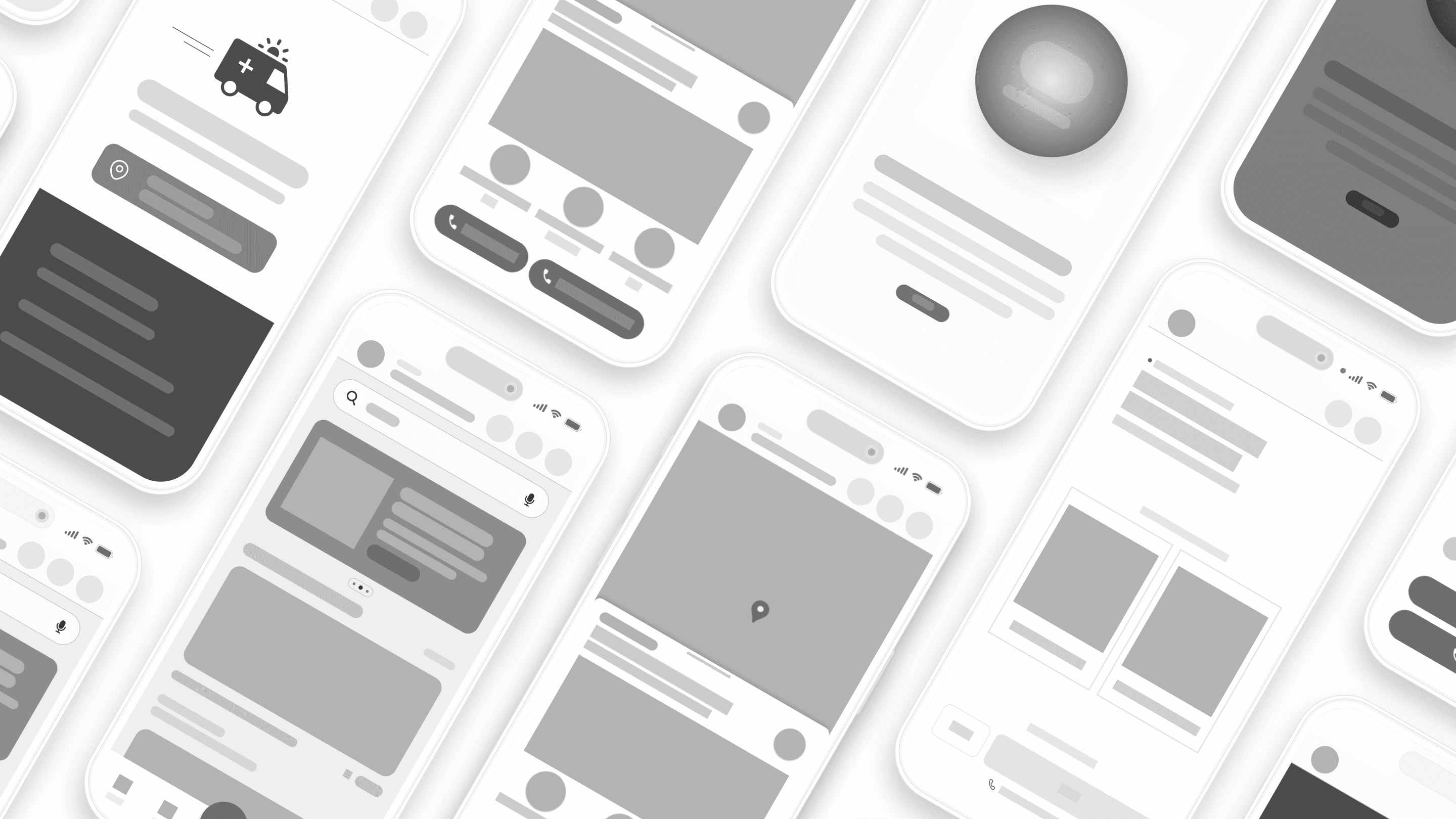
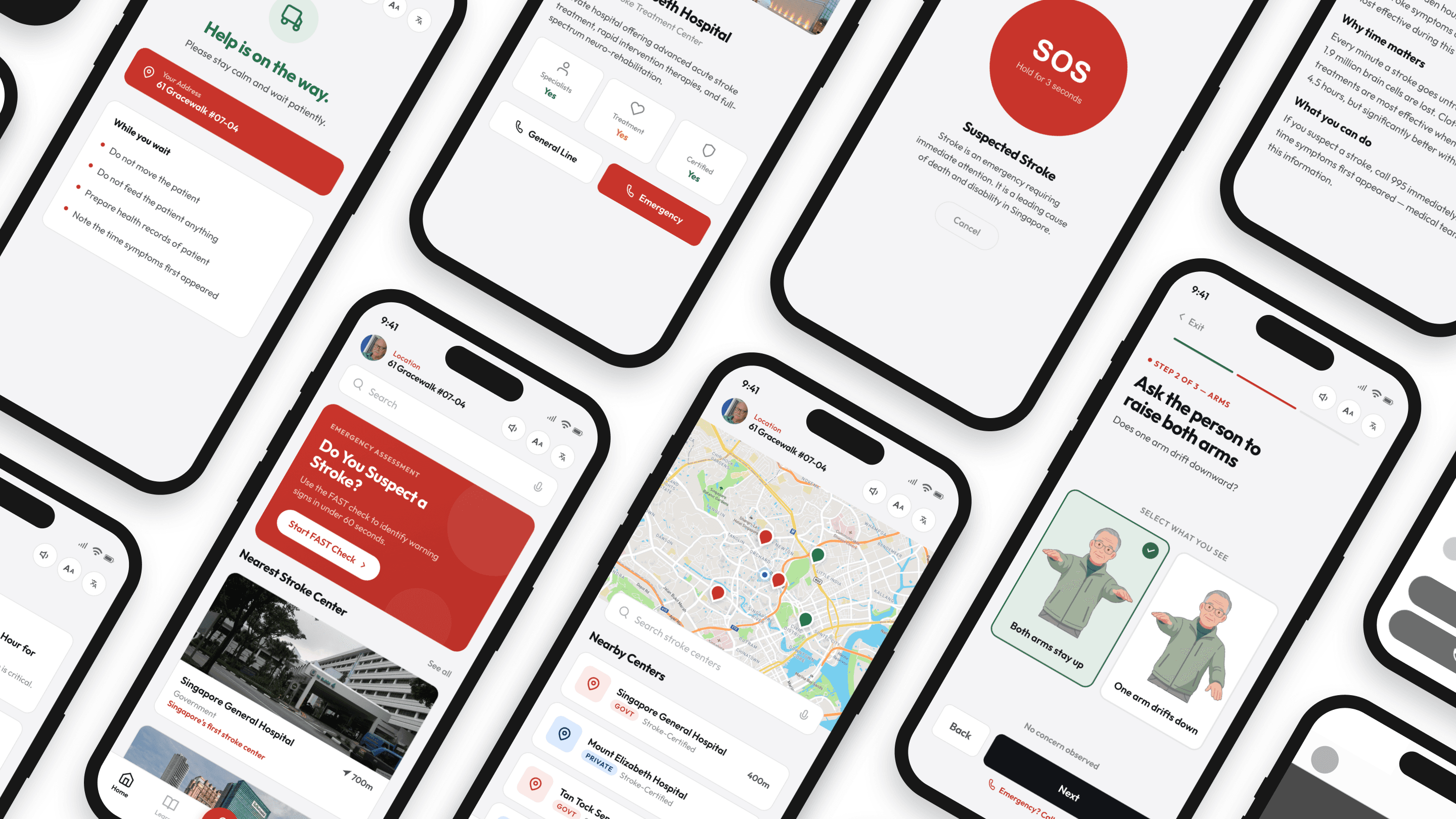
From wireframe to high-fidelity.
08 ACCESSIBILITY
Calm reading, even under stress.
StrokeReady uses plain language, large touch targets, high contrast, and one decision per screen to support users under stress. The interface removes non-critical information so bystanders can act quickly without overthinking.
LANGUAGE
5th-grade reading level
Plain words for panic moments. Short sentences, no jargon.
CONTRAST
7:1 minimum
Primary text exceeds AAA. Accent colours stay readable.
TOUCH TARGETS
96px primary actions
Large targets for shaking hands. 16px spacing between controls.
STRESS AFFORDANCE
One decision per screen
No back-stack required. Clear text prompt to be read.
LANGUAGE
5th-grade reading level
Plain words for panic moments. Short sentences, no jargon.
CONTRAST
7:1 minimum
Primary text exceeds AAA. Accent colours stay readable.
TOUCH TARGETS
96px primary actions
Large targets for shaking hands. 16px spacing between controls.
STRESS AFFORDANCE
One decision a screen
No back-stack required. Clear text prompt to be read.
LANGUAGE
5th-grade reading level
Plain words for panic moments. Short sentences, no jargon.
CONTRAST
7:1 minimum
Primary text exceeds AAA. Accent colours stay readable.
TOUCH TARGETS
96px primary actions
Large targets for shaking hands. 16px spacing between controls.
STRESS AFFORDANCE
One decision a screen
No back-stack required. Clear text prompt to be read.
09 REFLECTION
What I'd carry forward.
This project strengthened my interest in healthcare UX, especially products designed for high-stress moments. I learned that clarity matters most when users are frightened, distracted, or unsure what to do next.
WHAT WORKED
Compressing the FAST check to a single decision per screen — recall jumped without training.
WHAT'S UNVALIDATED
Real-world emergency conditions. All testing was simulated; live deployment needs clinical partners.
WHAT'S NEXT
Multilingual voice prompts, smartwatch trigger, and a caregiver-side dashboard for repeat-risk patients.
WHAT WORKED
Compressing the FAST check to a single decision per screen — recall jumped without training.
WHAT'S UNVALIDATED
Real-world emergency conditions. All testing was simulated; live deployment needs clinical partners.
WHAT'S NEXT
Multilingual voice prompts, smartwatch trigger, and a caregiver-side dashboard for repeat-risk patients.

StrokeReady helps people recognise stroke symptoms early and act with confidence in the first critical minutes.
01 WHY IT MATTERS
Every minute of delay costs roughly two million neurons.
adults worldwide will have a stroke in their lifetime.
Source · WHO / GBD, lifetime risk
of bystanders cannot name all four FAST signs unprompted
Source · MedStar Health Stroke Survey
neurons lost every minute an ischaemic stroke untreated
Source · Saver, Stroke 2006
adults worldwide will have a stroke in their lifetime.
Source · WHO, 2024
of bystanders cannot name all 4 FAST signs unprompted.
Source · WHO, 2024
Source · WHO, 2024
neurons lost every minute an ischaemic stroke untreated
adults will have a stroke in their lifetime.
Source · WHO, 2024
of bystanders cannot name all 4 FAST signs unprompted.
Source · WHO, 2024
Source · WHO, 2024
neurons lost every minute an ischaemic stroke untreated
In stroke emergencies, hesitation often happens before professional care begins. StrokeReady helps bystanders know what to check, who to call, and where to go in the first critical minutes.
In stroke emergencies, hesitation often happens before professional care begins. StrokeReady helps bystanders know what to check, who to call, and where to go in the first critical minutes.
02 COMPETITOR AUDIT
Existing apps treat strokes like trivia.
I reviewed three competitors and found the same pattern — static checklists, dense medical text, and no path to action.
FAST.ORG
REFERENCE APP
Static infographic. No interactive check, no call routing.
999 Apps
SYSTEM UTILITIES
Basic app. Dial out, but never confirm what the caller is seeing.
Health portals
MOH HEALTHHUB
Buried inside a wider health portal. Information-first, with no guided check or escalation.
03 INFORMATION ARCHITECTURE
Under stress, there should only be three choices.
FOCUS 01
Recognise
30-second guided FAST check, one prompt a time. No extensive reading required.
Voice-led prompts
Single-tap answers
Auto-timing
FOCUS 02
Escalate
A pre-filled emergency call with symptoms and onset time already logged.
Geo-routed dispatch
Spoken summary
Onset time captured
FOCUS 03
Reach
A map to the nearest stroke-ready hospital, with ETA and waiting guidance.
Stroke-centre filter
Live ETA
Wait-time guidance
FOCUS 01
Recognise
30-second guided FAST check, one prompt a time. No extensive reading required.
Voice-led prompts
Single-tap answers
Auto-timing
FOCUS 02
Escalate
A pre-filled emergency call with symptoms and onset time already logged.
Geo-routed dispatch
Spoken summary
Onset time captured
FOCUS 03
Reach
A map to the nearest stroke-ready hospital, with ETA and waiting guidance.
Stroke-centre filter
Live ETA
Wait-time guidance
FOCUS 01
Recognise
A 30-second guided FAST check, one prompt at a time. Not extensive reading required.
Voice-led prompts
Single-tap answers
Auto-timing
PILLAR 01
Escalate
Pre-filled call to local emergency services with the symptoms already logged.
Voice-led prompts
Single-tap answers
Auto-timing
PILLAR 01
Reach
Map view of the nearest stroke-certified hospital, ETA, and what to do while waiting.
Voice-led prompts
Single-tap answers
Auto-timing
04 FLOW
The FAST guided check redesigned
Face → Arms → Speech → Time
05 USER RESEARCH
Tested in 33 respondents across two age cohorts.
A primary google response survey with 33 unique respondents, with 8 follow-up interviews with caregivers of stroke patients.
completed the guided FAST check on first try, no instruction.
completed the guided FAST check on first try, no instruction.
said they'd keep the app installed after the test.
FAST signs recalled unprompted one week later.
completed the guided FAST check on first try, no instruction.
completed the guided FAST check on first try, no instruction.
said they'd keep the app installed after the test.
FAST signs recalled unprompted one week later.
completed the guided FAST check on first try, no instruction.
completed the guided FAST check on first try, no instruction.
said they'd keep the app installed after the test.
FAST signs recalled unprompted one week later.
06 PERSONA
Designed for the bystander, not the patient.
StrokeReady is designed for the person who notices the signs first — a daughter, roommate, coworker, or passerby. It does not replace medical professionals; it helps people recognise symptoms earlier and escalate faster.
StrokeReady is designed for the person who notices the signs first — a daughter, roommate, coworker, or passerby. It does not replace medical professionals; it helps people recognise symptoms earlier and escalate faster.
07 ITERATION
From wireframe to high-fidelity.
08 ACCESSIBILITY
Calm reading, even under stress.
StrokeReady uses plain language, large touch targets, high contrast, and one decision per screen to support users under stress. The interface removes non-critical information so bystanders can act quickly without overthinking.
LANGUAGE
5th-grade reading level
Plain words for panic moments. Short sentences, no jargon.
CONTRAST
7:1 minimum
Primary text exceeds AAA. Accent colours stay readable.
TOUCH TARGETS
96px primary actions
Large targets for shaking hands. 16px spacing between controls.
STRESS AFFORDANCE
One decision per screen
No back-stack required. Clear text prompt to be read.
LANGUAGE
5th-grade reading level
Plain words for panic moments. Short sentences, no jargon.
CONTRAST
7:1 minimum
Primary text exceeds AAA. Accent colours stay readable.
TOUCH TARGETS
96px primary actions
Large targets for shaking hands. 16px spacing between controls.
STRESS AFFORDANCE
One decision a screen
No back-stack required. Clear text prompt to be read.
LANGUAGE
5th-grade reading level
Plain words for panic moments. Short sentences, no jargon.
CONTRAST
7:1 minimum
Primary text exceeds AAA. Accent colours stay readable.
TOUCH TARGETS
96px primary actions
Large targets for shaking hands. 16px spacing between controls.
STRESS AFFORDANCE
One decision a screen
No back-stack required. Clear text prompt to be read.
09 REFLECTION
What I'd carry forward.
This project strengthened my interest in healthcare UX, especially products designed for high-stress moments. I learned that clarity matters most when users are frightened, distracted, or unsure what to do next.
WHAT WORKED
Compressing the FAST check to a single decision per screen — recall jumped without training.
WHAT'S UNVALIDATED
Real-world emergency conditions. All testing was simulated; live deployment needs clinical partners.
WHAT'S NEXT
Multilingual voice prompts, smartwatch trigger, and a caregiver-side dashboard for repeat-risk patients.
WHAT WORKED
Compressing the FAST check to a single decision per screen — recall jumped without training.
WHAT'S UNVALIDATED
Real-world emergency conditions. All testing was simulated; live deployment needs clinical partners.
WHAT'S NEXT
Multilingual voice prompts, smartwatch trigger, and a caregiver-side dashboard for repeat-risk patients.